
For stripers after dark, I look for 3 things: baitfish, moving water, and a sharp light-and-shadow edge. I cast from outside the feeding lane and work my lure along that edge, near deeper water.
Here’s my approach:
- Stay quiet: Keep lights off the water and avoid walking or boating through the feeding area.
- Match the conditions: Use paddletails, bucktails, or swimming plugs, with enough weight to reach the fish.
- Adjust before switching lures: Change the casting angle, then try a slower retrieve or a deeper path.
- Plan for safety: I check tides, weather, legal access, and fishing rules, pack night-fishing gear, and share my return time.
My rule: <u>fish the edge, not just the light</u> - and keep the presentation slow and controlled.
How to fish for Striped Bass on docks in the Bay at night. 2023 4K
Find Productive Dock-Light Water
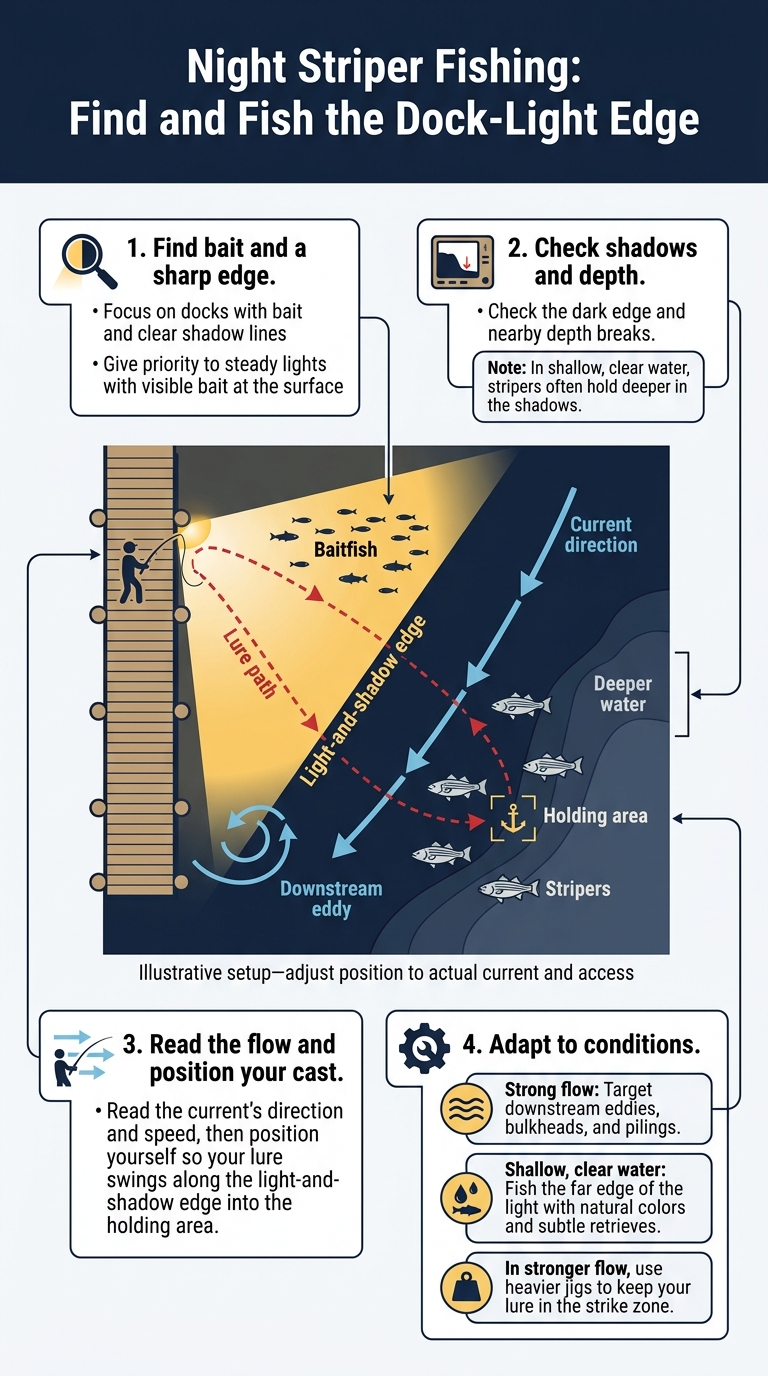
Night Striper Fishing: Find and Fish the Dock-Light Edge
Once you know stripers key on the seam, focus on docks with bait and clear shadow lines. The best dock lights form a sharp light-and-shadow edge where stripers can ambush bait without exposing themselves.
Look for Bait, Depth, and Shadow Edges
Check the dark edge and nearby depth breaks. In shallow, clear water, stripers often hold deeper in the shadows. Give priority to steady lights with visible bait at the surface.
- Strong flow: Target downstream eddies, bulkheads, and pilings.
- Shallow, clear water: Fish the far edge of the light with natural colors and subtle retrieves.
Once you find a promising seam, adjust your position to the tide so your lure reaches it naturally.
Choose Your Position by Tide and Current
Your position matters as much as the light. Read the current’s direction and speed, then position yourself so your lure swings along the light-and-shadow edge into the holding area. In stronger flow, use heavier jigs to keep your lure in the strike zone.
Approach Without Spooking Fish
Once you’ve found the seam, approach without alerting the fish.
Before moving closer, confirm legal access and assess the current, depth, and obstacles from a safe distance. Check your footing, casting room, and escape route in case water levels change.
Then keep a low profile.
Stay Quiet and Keep Lights Low on Shore
Step carefully, speak softly, and avoid banging tackle against railings. Stay outside the lit zone when possible, and point your headlamp at your footing or tackle - not across the water.
Whether you’re on foot or in a boat, stay out of the strike zone.
Keep Your Boat Outside the Feeding Lane
Shut off the motor early. Drift only if the current keeps you outside the feeding lane, and cast from outside the fish’s lane rather than moving through it.
If you can’t hold position without crowding the dock, move away and reset before casting.
Work Lures Along the Shadow Edge
Once you’re in position, focus on lure choice and retrieve rhythm. Stay outside the light, cast past the edge, and bring the lure back through the seam with the current. When possible, retrieve parallel to the shadow line. Try a different depth or speed before switching lures.
Choose Paddletails, Bucktails, or Swimming Plugs
Match your lure to the current and the depth where fish are holding. Choose a streamlined shape that tracks cleanly in moving water.
| Lure | Best use | Retrieve |
|---|---|---|
| Paddletail | Subtle movement along the light edge | Slow, steady swim with occasional twitches |
| Bucktail jig | Holds depth in current | Slow, controlled sweep or slow retrieve |
| Swimming plug | Covers water along the boundary | Steady swim with occasional twitches or hops |
Set Lure Depth, Speed, and Color
With sinking lures, let the lure drop, pause, then retrieve slowly. If the bite is quiet, try deeper water with a heavier, streamlined lure. Use black in clear water or chartreuse in murky water. Glow or reflective accents can help the lure stand out under dock lights.
Troubleshoot Missed Bites and Quiet Water
If bait is present but fish won’t commit, change your casting angle first, then slow your retrieve. Short strikes also call for a slower retrieve. When fish follow without biting, let the lure fall, pause, then bring it back slowly. In strong current, add weight cautiously and use a streamlined lure to keep it in the feeding lane.
Plan for Safe Night Fishing
Once you’ve found the seam, shift your focus from fishing tactics to safety checks.
Pack Lighting, Tackle, and Safety Gear
Pack a headlamp, pliers, line cutters, a landing net, a measuring tool, a first-aid kit, and a waterproof phone pouch.
On a boat, wear a properly fitted life jacket and check that all required boating safety gear is aboard before launching. From shore, wear non-slip footwear and keep your casting path clear of gear.
With everything packed, check access and conditions before heading out.
Check Conditions, Access, and Fishing Rules
Check tides and weather, confirm legal dock access, and make sure your fishing license is valid. Tell someone ashore your access point or launch site, planned route, and return time.
When fishing from shore, account for changing water levels and check bank stability. If you’re boating, confirm a safe route to and from the launch. Check the current, underwater obstacles, and launch conditions.
FAQs
Is an incoming or outgoing tide better for dock-light stripers?
Either tide can produce fish. The better choice depends on your location and how the current moves baitfish. Focus on moving water that carries bait along the edges between light and shadow, where stripers hunt, instead of favoring one tide.
Before heading out, check local tide forecasts and assess the current conditions at your specific access point.
How long should I fish a dock light before moving?
The article doesn’t say how long to fish a dock light before moving on.
What rod, reel, and line work best around dock pilings?
For striped bass around dock pilings, choose a medium or medium-heavy spinning or casting rod paired with a matching reel that has a smooth, reliable drag. Use braided main line for sensitivity and strength, then add a leader to resist abrasion and help present your bait or lure around the pilings.
Related Blog Posts
- How the First Nor'eastern of Fall Kicked the Striper Run Into Gear
- Connecticut River Mouth Fall Fishing: Stripers Stacked Up and Feeding
- False Albacore 101: How to Catch Fall's Fastest, Pickiest Fish
- Surfcasting October: Timing, Lures, and Tactics for Fall-Run Stripers
Rep Your Water
Stripers after dark? Wear it. The Connecticut River Fishing Club Tee is heavyweight garment-dyed cotton with a striped bass back graphic and a chest hit up front.