
My starting plan for fall stripers at the Connecticut River mouth: find bait, then fish moving water in low light. Near Old Saybrook and Old Lyme, I focus on 3 places: current seams, channel edges, and nearby flats.
Here’s how I plan the trip:
- Find feeding fish: I watch for diving birds and surface activity around dawn, dusk, or after dark.
- Match the bait and depth: I choose paddletails, swimming plugs, topwater, or live eels, with tackle suited to the current.
- Check before casting: I confirm Connecticut DEEP’s current license, size, and bait-hook rules, plus legal access.
- Put safety first: I check tides, weather, river conditions, footing, and boat traffic - and wear a fitted life jacket.
My rule: <u>bait first, casts second</u>. A tide forecast helps me plan, but what I see on the water guides where I fish.
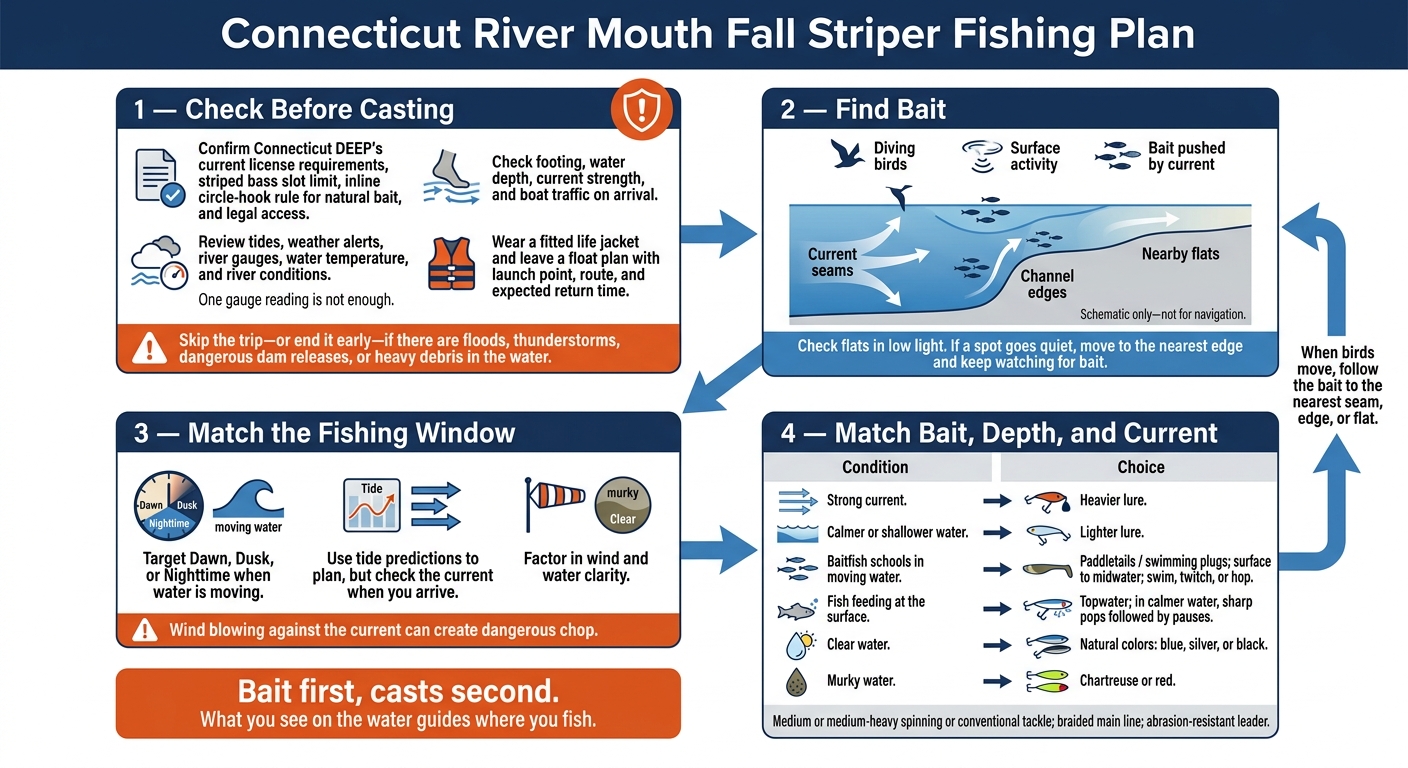
Connecticut River Mouth Fall Striper Fishing Plan
1. Find Bait and Choose When to Fish
Search Current Seams, Channel Edges, and Flats
At the Connecticut River mouth near Old Saybrook and Old Lyme, watch for bait pushed by the current, diving birds, and churning water. Then move to the current seam, channel edge, or nearby flat where the bait gathers.
Check flats in low light. If a spot goes quiet, move to the nearest edge and keep watching for bait.
Plan Around Tides and Low Light
Once you find bait, aim to fish the strongest moving water. Use tide predictions to plan, but check the current when you arrive. Target dawn, dusk, or nighttime periods when the water is moving.
Factor in wind and water clarity before deciding whether the window is worth fishing. When bait and tide line up, choose an offering that matches what the fish are eating.
2015 Fall Run Stripers Ct River
2. Match Your Offering to the Feeding Fish
Once you find the bait, switch to a lure that stays in the strike zone as it moves through the current seams and edges you found earlier.
Choose Paddletails, Swimming Plugs, and Topwater
Match your lure’s shape to the bait in the water. Slender profiles mimic baitfish, while bulkier shapes imitate other prey. Use natural colors like blue, silver, or black in clear water. In murky water, chartreuse or red makes the lure easier to see.
- Lure weight: Go heavier in strong current and lighter in calmer or shallower water.
- Paddletails / swimming plugs: Work these around baitfish schools in moving water, from the surface to midwater. Swim, twitch, or hop them.
- Topwater: When fish rise to feed at the surface, switch to topwater. In calmer water, use sharp pops followed by pauses.
3. Prepare Gear, Check Rules, and Stay Safe
Choose Tackle for Strong Current
Once you find feeding fish, choose gear that can handle the current. Medium or medium-heavy spinning or conventional tackle, braided main line, and an abrasion-resistant leader help you control your offering along seams and edges.
Pack for the trip: Bring pliers, a landing net, a measuring device, a light, layered clothing, a life jacket, a first-aid kit, and waterproof communication gear. Include polarized glasses, sunscreen, and insect repellent.
Check Connecticut Fishing Rules
Check Connecticut DEEP’s current striped bass regulations and license requirements before fishing. Confirm the current slot limit and the inline circle-hook rule for natural bait.
Measure each fish before deciding whether to keep it, and immediately release any fish outside the legal limit. Wet your hands before handling fish, support their bodies, and keep their time out of the water as short as possible. Keep pliers within reach for hook removal.
Watch Current, Boat Traffic, and Slippery Rocks
Before fishing the river mouth, review lower-river tide forecasts, river gauges, water temperature, and weather alerts. One gauge reading is not enough. Once you arrive, check your footing, water depth, current strength, and boat traffic. Wind blowing against the current can create dangerous chop.
Wear a fitted life jacket and stay off slippery or unstable surfaces. Never anchor in a navigation channel or near a dam. For family outings, choose stable banks with confirmed legal access, away from steep edges and fast-moving currents.
Leave a float plan that includes your launch point, route, and expected return time. Skip the trip - or end it early - if there are floods, thunderstorms, dangerous dam releases, or heavy debris in the water.
Conclusion: Follow the Bait and Adjust Your Approach
Watch for diving or hovering birds. They point to bait near the surface and the next feeding lane. When the birds move, follow the bait to the nearest seam, edge, or flat, then cast quickly into the feeding lane.
FAQs
Which fall months are best for stripers at the Connecticut River mouth?
Fall is a common season for targeting stripers in the lower Connecticut River, though the guidance doesn’t name specific months as best. Focus on moving tides and the presence of baitfish - the main triggers for active feeding in fall.
Is the incoming or outgoing tide better for stripers here?
Neither incoming nor outgoing tide is always better for stripers in the lower Connecticut River. Moving water and baitfish presence matter more, with water temperature and wind also shaping conditions.
During active tidal movement, target current seams and channel edges where baitfish gather. The better tide is the one that puts current and bait movement in your favor when you fish.
When should I choose live eels over lures?
Live eels offer a natural presentation that can trigger strikes from striped bass concentrated in the lower Connecticut River. Soft-plastic paddletails and swimming plugs work well for covering water and matching local baitfish, while live eels are a strong choice for enticing bites.
Always check current local fishing regulations, including bait-hook rules and size limits, to make sure your bait and setup comply.
Related Blog Posts
- Fishing the Connecticut River: A Guide to New England's Great River
- The Best Fish to Catch in the Connecticut River
- Fall Striper Run 2026: Where the Migration Stands Right Now
- How the First Nor'eastern of Fall Kicked the Striper Run Into Gear
Rep Your Water
Fish the Connecticut River? Wear it. The Connecticut River Fishing Club Tee is heavyweight garment-dyed cotton with a striped bass back graphic and a chest hit up front.