
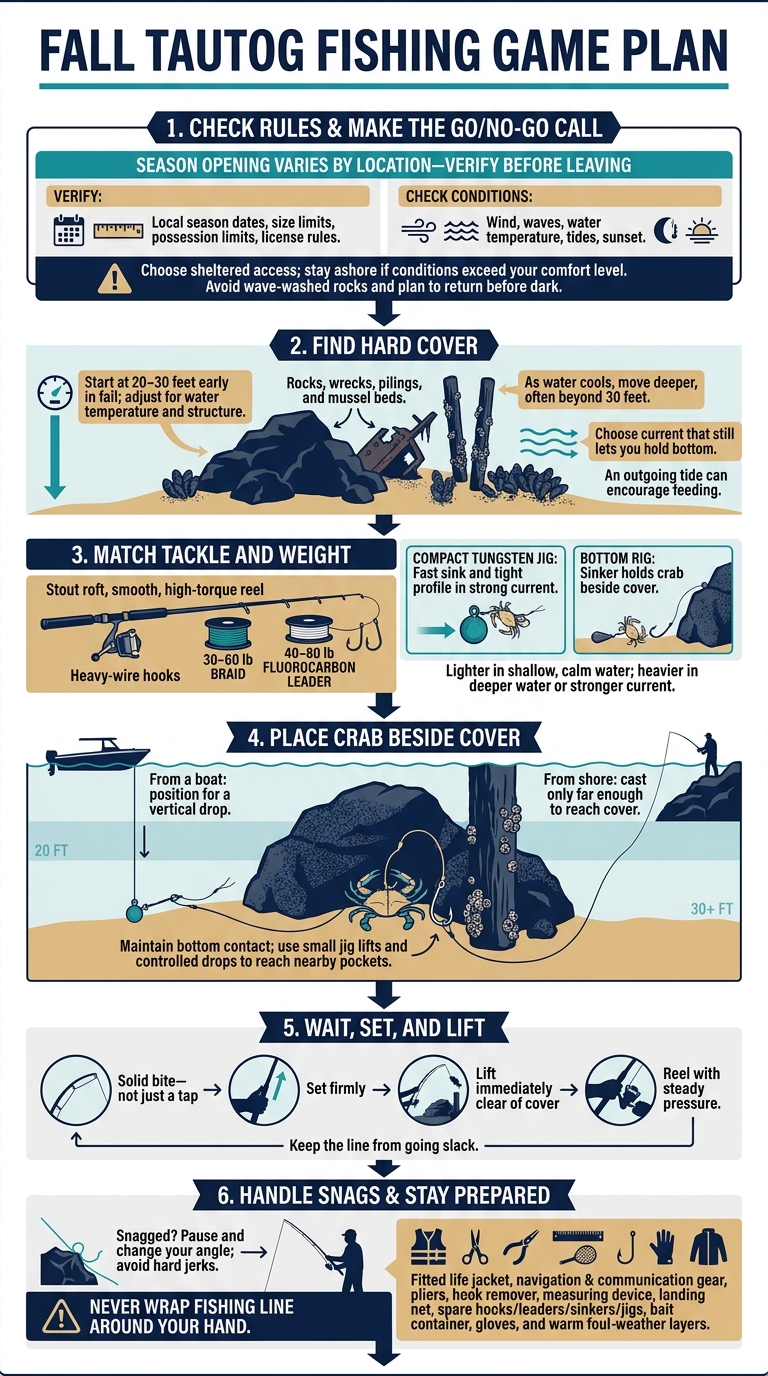
My fall tautog plan starts with local rules, crab bait, and rocky cover - not long casts. For an October 20, 2026 trip, I’d first confirm that the season is open in your waters, plus size limits, possession limits, and license rules.
- Find the fish: Start around 20–30 feet near rocks, wrecks, or pilings, then adjust for water temperature and current.
- Control the bait: Choose a jig or bottom rig heavy enough to keep crab beside cover. Stay in contact, wait for a firm bite, then set and lift the fish clear.
- Plan for snags and safety: Pack spare tackle, pliers, a measuring device, and a landing net. Never wrap fishing line around your hand.
- Make the go/no-go call: I’d check wind, waves, tides, and sunset, pack a fitted life jacket and warm layers, and avoid wave-washed rocks.
My rule: fish close to cover, but <u>put safe access and sea conditions first</u>.
Fall Tautog Fishing Game Plan
Find Structure and Choose Your Tide
Look for Rocks, Wrecks, Pilings, and Mussel Beds
With the rules set, focus on hard cover: jetties, pilings, wrecks, rock piles, and mussel beds where tautog shelter and feed. Keep your crab bait tight to one piece of cover rather than spreading your effort across a broad area.
Start at 20–30 Feet and Follow the Conditions
Start in 20–30 feet early in fall, adjusting for water temperature and structure. As the water cools, move deeper, often beyond 30 feet.
Look for moving water that still lets you hold bottom. An outgoing tide can get fish feeding as it pushes bait out of cover.
Position Your Boat or Cast From Shore
Position your boat so your bait stays close to the target and on the bottom. From shore, cast only far enough to reach the cover - extra distance can pull your crab away from it.
Once your position and tide line up, match your rig and bait to the bottom.
Fall Tautog Fishing Tips, Part 1
Choose Tackle, Crab Bait, and Rigs
Once you know the structure and tide, match your tackle to the bottom and current.
For bait control around rocks, wrecks, and pilings, use a stout rod, a smooth high-torque reel, 30–60 lb braid, a 40–80 lb fluorocarbon leader, and heavy-wire hooks to handle abrasion. Pack spare hooks, leaders, sinkers, and jigs. After the trip, rinse terminal tackle with clean tap water.
Choose a Tautog Jig or Bottom Rig
Choose a compact tungsten jig in strong current when you need a fast sink and a tight profile. For a bottom rig, use a sinker to keep crab bait beside cover.
Match Your Weight to Depth and Current
Go lighter in shallow, calm water. Use heavier weights in deeper water or when the current pulls your line away from structure.
With your rig ready, prepare your crab bait, checking its size and how recently it was caught.
Fish the Bottom and Pull Tautog From Cover
With your rig matched to the depth and current, stay tight to the bottom and work each target thoroughly.
Fish Each Target Before Moving
Drop vertically to reduce snagging. Let the bait settle, then keep enough contact to hold it beside cover. With a jig, use small lifts and controlled drops to reach nearby pockets.
Detect the Bite and Set the Hook
Once the bait is in the zone, watch for a solid bite - not just a tap. Set the hook firmly, then lift immediately to pull the fish away from cover.
Keep steady pressure as you reel, and don't let the line go slack. A smooth drag helps maintain pressure during sudden runs.
Free Snags and Handle Fish Safely
If the rig snags, pause and change your angle of pull. Avoid hard jerks, and never wrap the line around your hand.
Keep control until the fish is clear of the structure.
Conclusion: Check Conditions Before You Go
Check Wind, Waves, Water Temperature, and Sunset
Before heading to the rocks or wrecks, check conditions one last time. Review the local marine forecast, wind, waves, water temperature, tides, and sunset. Fall weather can trigger turnover: cooling surface water mixes with deeper water, which can change fish activity.
Choose a sheltered access point, or stay ashore if conditions exceed your comfort level. Plan to return before dark.
Pack Safety Gear, Tackle, and Layers
Pack fitted life jackets, navigation and communication gear, pliers, a hook remover, a measuring device, and a landing net. Bring spare tackle, a bait container, gloves, and warm foul-weather layers, too.
Run Your Pre-Departure Checklist
Use this final check to catch anything you missed.
- Rules: Verify local season dates before leaving.
- Fishing plan: Pack crab bait and spare weights. Confirm the tide and the structure you’ll fish.
- Go/no-go: Recheck the forecast, sunset, and boat or shore safety gear.
Fish tight to the bottom and stay ready to lift fish clear of cover.
FAQs
How should I hook green crabs or Asian shore crabs?
Remove the crab’s claws to help keep tautog from picking at the bait without taking it fully. Thread the hook through a rear leg socket, then push the point out through the shell. This holds the bait in place as tautog crush it.
Use a tautog jig or bottom rig to keep the bait directly on the rocky structure where tautog feed.
When should I use a tautog jig instead of a bottom rig?
A tautog jig gives you a direct, sensitive connection to your bait, making subtle bites around rocks easier to feel. It presents bait naturally and gives you precise control to pull fish away from snags fast.
Choose a bottom rig when you need multiple hooks to try different baits or more weight to hold bottom in strong currents. Let the depth and current strength guide your choice.
How long should I fish a spot without a bite?
Give each spot 15 to 20 minutes when targeting tautog. These fish stick close to structure, so if they’re there and feeding, you should get bites within that window. No bites? Move to another patch of rocky structure and look for more active fish.
Related Blog Posts
- Fall Striper Run 2026: Where the Migration Stands Right Now
- Connecticut River Mouth Fall Fishing: Stripers Stacked Up and Feeding
- Cape Cod Fall Fishing Guide: Stripers, Bluefish, and Giant Tuna
- Night Fishing for Stripers: Dock Lights and After-Dark Tactics
Rep Your Water
Cracking green crabs for fall tog? Wear it. The Black Lagoon Fishing Club Tee is heavyweight garment-dyed cotton with a creature-feature back graphic.