
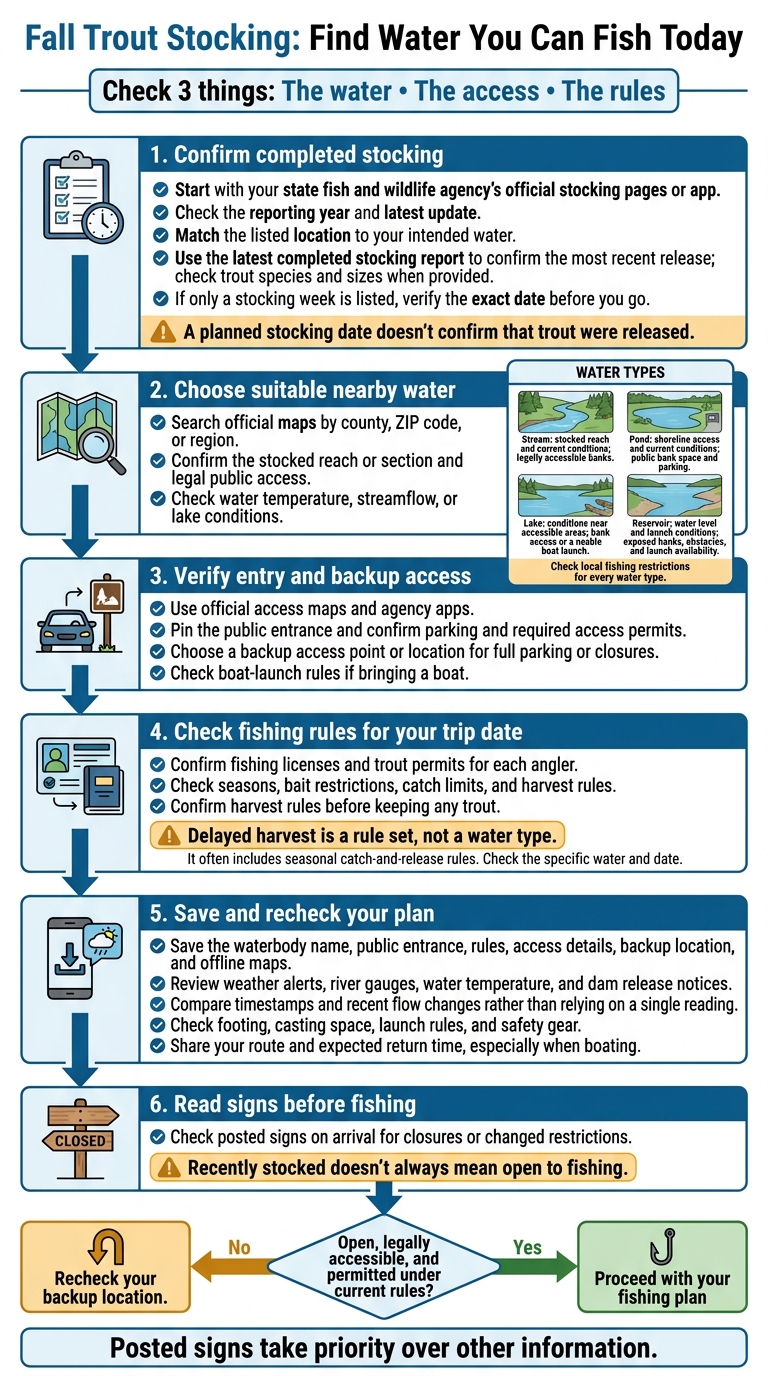
I start with my state fish and wildlife agency’s latest completed stocking report, not just its schedule. A planned stocking date doesn’t confirm that trout were released.
Before choosing where to fish, I check 3 things:
- The water: Recent stocking date, trout species and sizes, and current water conditions.
- The access: Public entry points, parking, and boat-launch rules.
- The rules: Licenses, trout permits, seasons, bait restrictions, and harvest limits - including delayed-harvest rules.
Then I save offline maps, pick a backup spot, and check weather, streamflow, and dam releases. My final check happens at the water: <u>read posted signs for closures or changed restrictions</u>. Recently stocked doesn’t always mean open to fishing.
Fall Trout Stocking: Find Water You Can Fish Today
Fall trout stocking complete after delay due to weather and water levels
Step 1: Check Your State’s Fall Trout Stocking Schedule
Start with your state fish and wildlife agency’s official trout stocking pages and app, if available. Find the current schedule and stocking reports, then use them to narrow your list to waters stocked most recently.
Check Dates, Locations, and Stocking Status
Check the reporting year and latest update before relying on a listing. Then read each entry’s date or stocking week and location name. Make sure the entry refers to the water you plan to fish.
Read Your State’s Stocking Reports
Use the newest report to confirm when your chosen water was last stocked. If the report lists only a stocking week, verify the exact date before you go.
Step 2: Choose a Nearby Stocked Water
Narrow your list to waters you can legally reach and fish today.
Find Local Waters and Confirm the Last Stocking
Search official stocking maps by county, ZIP code, or region, and check the latest stocking date. Then pair the stocking report with a public-access map or app to confirm legal access to the stocked section.
Check Trout Species, Sizes, and Water Conditions
Check which trout species were stocked and their sizes. Then review water temperature, streamflow, or lake conditions before choosing where to fish.
Compare Streams, Ponds, Lakes, and Reservoirs
Choose a water type based on access, current conditions, and fishing rules.
| Water type | What to verify | Access needs | Regulation checks |
|---|---|---|---|
| Stream | Stocked reach and current conditions | Legally accessible banks | Local fishing restrictions |
| Pond | Shoreline access and current conditions | Public bank space and parking | Local fishing restrictions |
| Lake | Water conditions near accessible areas | Bank access or a usable boat launch | Local fishing restrictions |
| Reservoir | Water level and launch conditions | Exposed banks, obstacles, and launch availability | Local fishing restrictions |
Delayed harvest is a rule set, not a water type. It often includes seasonal catch-and-release rules. Check the rules for that specific water and date before you go.
Step 3: Check Public Access and Fishing Rules
Find Public Entry Points and a Backup Location
Once you’ve chosen a newly stocked waterbody, confirm where you can legally enter and fish. Use official access maps and agency apps to find public entry points and required permits.
Pin the public entrance and choose a backup access point in case parking is full or a closure blocks your first choice. If you’re bringing a boat, check the boat-launch rules, too.
Check Licenses, Permits, and Local Restrictions
Check whether each angler needs a fishing license and trout permit. Read the waterbody’s rules for your trip dates, including seasons, catch limits, and bait restrictions. Confirm harvest rules before keeping any trout.
Save Your Trip Plan and Check Gear
Save the waterbody name, public entrance, rules, and access details so you can view them offline. Before you go, check footing, casting space, launch rules, and safety gear.
Conclusion: Review Your Pre-Trip Checklist
Before you leave, confirm that your chosen water is still stocked and open. Check the official fall stocking schedule, the latest completed stocking report, mapped public entry points, valid licenses and permits, and the waterbody’s rules.
Review weather alerts, river gauges, water temperature, and dam release notices. Compare timestamps and recent flow changes rather than relying on a single reading.
Save your plan, backup location, and offline maps. Share your route and expected return time with someone, especially if you’re heading out by boat. Posted signs take priority over other information. Read them when you arrive to check for closures or changed restrictions before fishing.
FAQs
How soon after stocking should I fish?
The information provided doesn’t say how soon you can fish after stocking. Check your state fish and wildlife agency’s official guidelines for advice on when to fish after a stocking event.
Do stocked trout stay near the release point?
The available information doesn’t confirm whether stocked trout stay near the release point. It only suggests fishing cold-water stretches and shaded tributary pools, and checking conditions and regulations for your waterway.
For a definite answer, check your state’s stocking or dispersal guidance, or reports for that location.
What if my local stocking report is outdated?
Don’t rely on it alone. Check official state wildlife or environmental agency websites for the latest updates and timestamps. Ask a local bait shop or outdoor store about recent stocking activity and what’s working nearby.
Before heading out, review local river gauges and water temperatures. Check posted signs at your access point to confirm the waterway is suitable and open for fishing.
Related Blog Posts
- Fishing the Connecticut River: A Guide to New England's Great River
- The Best Fish to Catch in the Connecticut River
- Fall Striper Run 2026: Where the Migration Stands Right Now
- Connecticut River Mouth Fall Fishing: Stripers Stacked Up and Feeding
Rep Your Water
Freshly stocked water, fresh gear. The Black Lagoon Fishing Club Tee is heavyweight garment-dyed cotton with a creature-feature back graphic.