
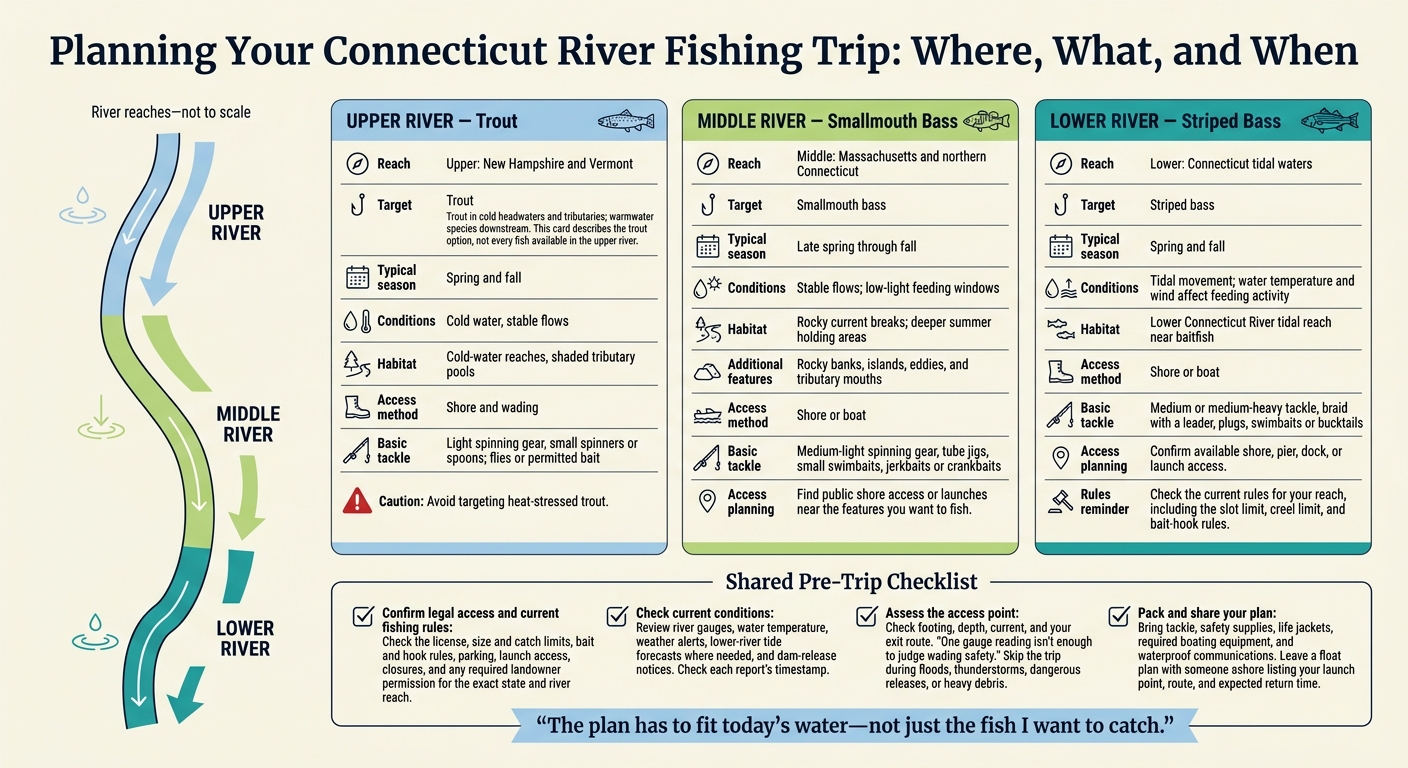
I plan a Connecticut River fishing trip around 3 choices: where to fish, what to target, and when to go. My starting point: trout in the cold upper river, smallmouth bass in the middle reaches, or striped bass in Connecticut’s tidal waters.
- Trout: I look for cold water in spring or fall and pack light tackle.
- Smallmouth bass: I focus on rocks and current breaks from late spring through fall, using jigs or small swimbaits.
- Striped bass: I check moving tides and baitfish in spring or fall, with medium or medium-heavy tackle.
Before heading out, I confirm <u>legal access and current fishing rules</u>, then check flows, weather, water temperature, and tides where needed. Shore or boat, I pack safety gear and share my route and return time. The plan has to fit today’s water - not just the fish I want to catch.
Connecticut River Fishing: Where, When, and What to Target
Day at the Office: Fly Fishing the Upper Connecticut
sbb-itb-d0a8c9d
Choose Your River Reach and Access Point
Confirm legal public access before choosing tackle. A productive bank or launch in one reach doesn’t guarantee access in another.
| River reach | Target species and habitat | What to check | Access and tackle planning |
|---|---|---|---|
| Upper: New Hampshire and Vermont | Trout in cold headwaters and tributaries; warmwater species downstream | Access, flow, and water conditions for that exact reach | Plan separately for trout water and downstream fishing, and match tackle to your target species |
| Middle: Massachusetts and northern Connecticut | Smallmouth bass around rocky banks, islands, eddies, and tributary mouths | Access, flow, and water conditions for that exact reach | Find public shore access or launches near the features you want to fish |
| Lower: Connecticut tidal waters | Striped bass in tidal waters | Local access, tides, and species guidance for the exact tidal reach | Confirm available shore, pier, dock, or launch access |
Use the table to narrow your options based on the species you want to target.
Upper River: New Hampshire and Vermont
Head to cold headwaters and tributaries for trout. For warmwater species, focus on downstream reaches and choose tackle to suit those fish.
Middle River: Massachusetts and Northern Connecticut
Look for public banks and launches near rocky banks, islands, eddies, and tributary mouths. These features make the middle river a strong smallmouth bass destination.
Your access type shapes where you can fish and what you’ll need to bring.
| Decision | Shore fishing | Boat fishing |
|---|---|---|
| Mobility | Limited to legally accessible banks | Requires a usable launch and a safe route to the water |
| Equipment | Check footing and room to cast | Check launch requirements and boating safety gear |
| Cost | Verify parking or entrance charges | Verify launch fees and operating costs |
| Safety | Assess footing and changing water levels | Assess current, obstacles, and launch conditions |
Lower River: Connecticut Tidal Waters
Before you go, check striped bass access, tides, and species guidance for the exact tidal stretch. A dock, pier, or launch doesn’t necessarily give you fishing access to the whole area.
Match your season, flows, and tackle to your chosen reach, access point, and target fish.
Choose the Season and Tackle for Your Target Fish
Pick your target fish, then match your timing and tackle to the water conditions. Once you’ve chosen your river reach, use this table to plan your trip.
| Target fish | Typical season | Water conditions | Habitat | Shore or boat | Basic tackle |
|---|---|---|---|---|---|
| Trout | Spring and fall | Cold water, stable flows | Cold-water reaches, shaded tributary pools | Shore and wading | Light spinning gear, small spinners or spoons; flies or permitted bait |
| Smallmouth bass | Late spring through fall | Stable flows; low-light feeding windows | Rocky current breaks; deeper summer holding areas | Shore or boat | Medium-light spinning gear, tube jigs, small swimbaits, jerkbaits or crankbaits |
| Striped bass | Spring and fall | Tidal movement; water temperature and wind affect feeding activity | Lower Connecticut River tidal reach near baitfish | Shore or boat | Medium or medium-heavy tackle, braid with a leader, plugs, swimbaits or bucktails |
Trout: Cool Water and Steady Flows
Focus on cold-water reaches and shaded tributary pools in the upper river where fishing is allowed. Small spinners, spoons, flies, or permitted bait are good options. Avoid targeting heat-stressed trout.
Smallmouth Bass: Rocks and Current Breaks
Work tube jigs or small swimbaits along current seams and in deeper summer holding water. In low light, try topwater lures. Check flows before wading or launching.
Striped Bass: Moving Tides and Baitfish
In the lower Connecticut River tidal reach, plan around moving tides and baitfish presence. Account for water temperature and wind, too. Use medium or medium-heavy tackle with braid and a leader for plugs, swimbaits, bucktails, or lawful bait.
Check the current rules for your reach, including the slot limit, creel limit, and bait-hook rules.
Check Fishing Rules, River Conditions, and Gear
Once you’ve picked your river reach and target fish, make sure the trip is legal, safe, and worth the drive.
Verify Licenses, Catch Limits, and Access
Check the current rules for your exact state and river reach. Confirm which license you need, size and catch limits, bait and hook rules, parking, launch access, closures, and any required landowner permission. With access sorted out, check river conditions before you launch or wade.
Check Flow, Water Temperature, and Tides
Before leaving, review river gauges, water temperature, weather alerts, lower-river tide forecasts, and dam-release notices. Make sure today’s conditions suit your target fish, and check each report’s timestamp. One gauge reading isn’t enough to judge wading safety.
At the access point, assess footing, depth, current, cover, baitfish activity, and your exit route. Skip the trip during floods, thunderstorms, dangerous releases, or heavy debris. If the reported conditions fit your plan, pack the right safety gear before heading out.
Pack Tackle and Safety Supplies
Pack your rod, tackle, bait, pliers, landing net, and measuring tool, plus polarized glasses, sunscreen, insect repellent, and a first-aid kit. Bring life jackets, required boating equipment, and waterproof communications.
Leave a float plan with someone ashore that lists your launch point, route, and expected return time. Don’t anchor near dams or in navigation channels. Supervise children on stable banks, away from steep edges and fast current.
Conclusion: Review Your Pre-Trip Checklist
You’ve chosen your river reach, target fish, and gear. Before heading out, check conditions for that reach and species, check your flotation gear, and review your float plan. Share your return time with someone ashore, and clear up any uncertainty before you leave.
For local advice, ask a bait shop or outdoors store what’s working now.
FAQs
Do I need separate licenses to fish across state lines?
Yes, you generally need a valid fishing license for each state where you fish. On the Connecticut River, follow the license rules, catch limits, and other fishing regulations for the state where you cast your line.
Before you go, check each state’s official wildlife or environmental agency website. Confirm that you have the required documents and understand local safety guidelines and legal requirements.
How can I find legal public fishing access?
Check official state wildlife or environmental protection agency websites for your stretch of the Connecticut River. You’ll find maps showing public boat launches, fishing piers, and shore access points.
Before heading out, make sure you have the required state fishing license, and review current catch limits and safety guidelines. When you arrive, read the posted signs to confirm public access and check for any restrictions.
What water temperature is too warm for trout?
The provided search results don’t state what water temperature is too warm for trout.