

Here’s the short answer: I’d treat the 1817 Gloucester story as a set of reported sightings, not proof of a giant sea serpent.
In the article, I see a clear pattern: people around Gloucester, Massachusetts, reported something unusual on August 6 and August 10, 1817, but the descriptions did not match well enough to point to one clear animal. Some witnesses said 45 feet. Others went as high as 100 feet. The head was compared to a horse, dog, turtle, and snake. That kind of spread matters.
If you just want the main takeaways, here they are:
- Yes, sightings were reported off Gloucester in August 1817
- No, the reports do not prove a confirmed sea serpent
- Witness accounts conflicted on size, shape, and head form
- Early newspapers help preserve the first versions of the story
- Later retellings helped turn uneven reports into a fixed legend
- The most likely answer is misidentification or a strange view of a known marine animal
Put simply: the record supports an event people talked about, but not a settled case for an unknown monster.
A few facts stand out right away:
- Reported length ranged from 45 to 100 feet
- Sightings came from both shore and boats
- Locations included Gloucester Harbor, Rocky Neck, Ten Pound Island, and Gloucester Roads
- The article’s own bottom line is that documented sightings are not the same as proof
I’d read this case as a good example of how a local report can grow. First, people see something. Then descriptions clash. Then print spreads the story. After that, the legend becomes cleaner than the source material ever was.
That’s the point I’d keep in mind as you read the rest of the article.
The First Gloucester Sightings and the People Involved
August 1817: Where the Reports Began
The first reports trace the sightings to August 6 and August 10, 1817, in and around Gloucester Harbor, Rocky Neck, Ten Pound Island, and Gloucester Roads. People onshore said they saw it. So did people out in boats.
That mix matters. A sighting from land can look very different from one seen on the water, even when both are watching the same thing. Distance, angle, motion, and even the state of the harbor can shape what people think they saw.
The record that survives here is a bit uneven. It does not keep every witness name or explain each person’s role. And the reports don’t line up in every detail. That’s exactly why the witness descriptions matter in the next part. They help show not just what was reported, but who reported it and from where.
sbb-itb-d0a8c9d
What Witnesses Claimed to See
Repeated Descriptions of Size, Shape, and Movement
Witnesses put the creature somewhere between 45 and 100 feet long. Many said it had a brown body with barrel-like or hump-like sections. The head drew a lot of comparisons too. Depending on the account, it looked like a horse, dog, turtle, or snake.
That sounds specific at first glance. But once you line the stories up side by side, the picture gets blurry. The same sighting story kept shifting depending on who told it.
Where the Accounts Disagree
The accounts clash on the big details: length, body shape, and head form. No single description lines up with all of them. That mismatch matters.
Instead of one clear picture, there were bits and pieces that didn’t quite fit together. Later retellings stepped into those gaps and turned the rough, uneven reports into a more fixed monster.
How the Story Became a Sea Serpent Legend
From Gloucester Harbor to Regional Newspapers
The earliest newspaper reports give us the clearest surviving record of the 1817 Gloucester sightings because they locked in the first versions before later retellings started to shift the story. That point matters. When you look at those early reports, you don't see one clean account. You see named witnesses, mixed details, and descriptions that already clash with each other.
How Retelling Changed the Creature
Once those accounts began to spread, the gaps almost invited people to smooth the story out. Later retellings took witness reports that didn't line up and turned them into a more fixed sea serpent legend. On the page, the story was easy to pass along and much harder to check.
What Was the Gloucester Sea Serpent?
What the Evidence Supports and What It Does Not
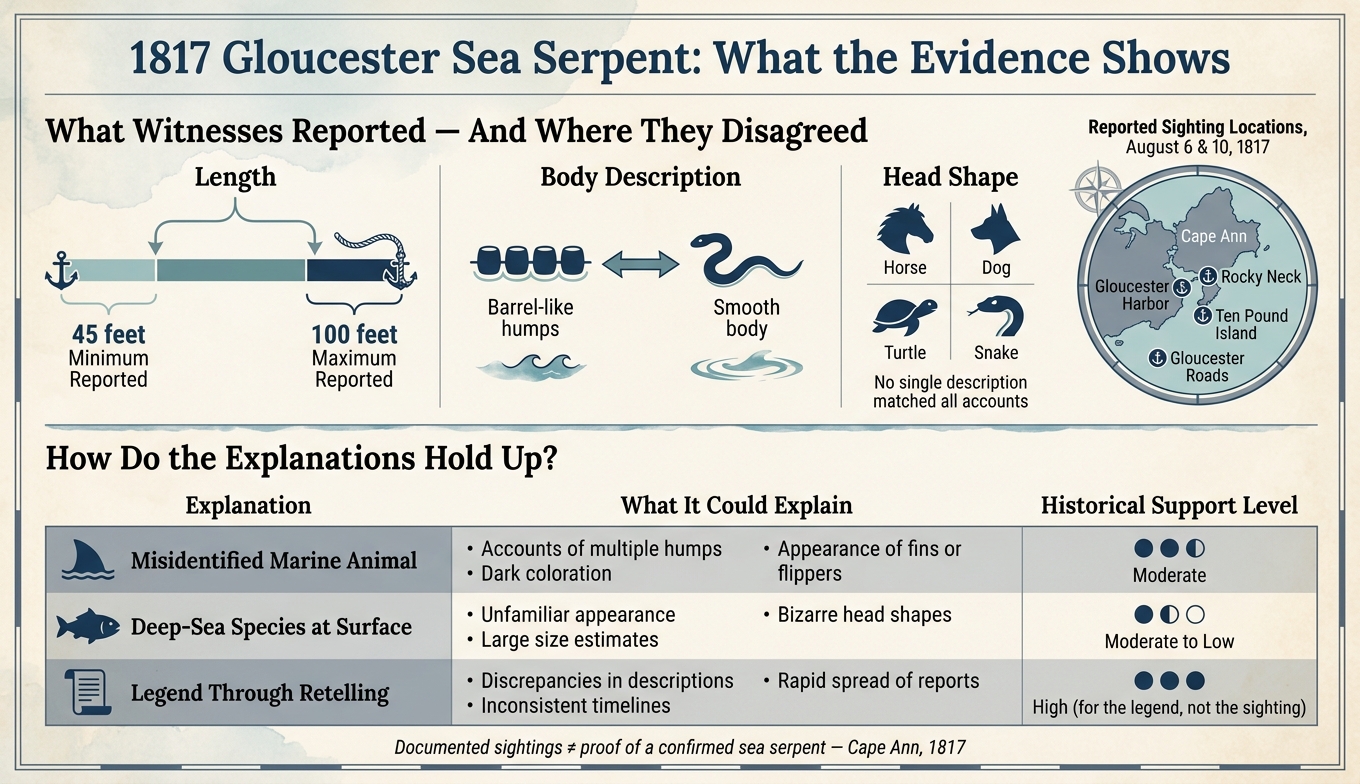
1817 Gloucester Sea Serpent: Witness Accounts vs. Plausible Explanations
Plausible Explanations for What People Saw
Those reports matter. But they still don't settle the creature's identity.
The 1817 Gloucester reports show that people saw something unusual offshore. What they do not show is proof of a giant unknown serpent.
The most common explanation is simple: misidentification. A known animal seen only for a moment, from far away, or in rough water can look strange fast. That includes deep-sea species that rarely come to the surface. A large animal moving near the top of the water can seem much stranger than it is.
Explanations Compared Against the Historical Record
The main explanations don't fit the 1817 descriptions equally well.
| Explanation | Details It Could Account For | Details It Does Not Fully Explain | Degree of Historical Support |
|---|---|---|---|
| Misidentified marine animal | An unusual shape or movement in the water | A single, definite species | Moderate |
| Known deep-sea species seen at the surface | Strange features that seemed unfamiliar to observers | Why the animal would be at the surface | Moderate to low |
| Retelling | How the legend grew | The original 1817 sightings | High for explaining the legend, not the sighting |
Conclusion: Documented Reports vs. Legend
Here's what the 1817 record supports: people around Gloucester reported something unusual, and named witnesses were tied to the account. That's a meaningful historical record.
At the same time, the descriptions don't point cleanly to one creature. And the sea serpent label is a later interpretation, not a documented fact.
The key distinction is simple: documented sightings are not proof of a confirmed sea serpent.
FAQs
Why do the witness accounts conflict so much?
The sources available here don't explain why the witness accounts differ so much.
And because they leave out the details of the 1817 Cape Ann sea serpent sightings, this question can't be answered from those sources alone.
Could more than one animal have caused the sightings?
The provided sources do not discuss the 1817 Cape Ann sea serpent sightings. They also do not say whether more than one animal may have been behind those reports.
So, based on the sources provided, this question can’t be answered.
Why did the story become a sea serpent legend?
The sources provided don’t say why the 1817 Cape Ann sea serpent story later turned into a legend.
So, based on those sources alone, there’s no solid way to answer that question.